
Gameplay Impressions
Ubisoft Montreal has clearly taken a good look at the criticisms made by reviewers of the first game and has acted upon them to deliver a more polished and all-round more entertaining adventure. Though the open-world locations still offer a lot of room for exploration, Assassin's Creed 2 feels much more compact and focused then the last game, offering a diverse range of missions that are scattered more densely than they were in Assassin's Creed, while putting less focus on dialogue, overly detailed conversations and long drawn out quests that required boring journeys.
The storyline, though we have yet to reach its conclusion (and pray that is better than the first game,) is absorbing from the out-set and the majority of characters that we've met thus far are likable, interesting and charismatic. Though the "Mama-Mia!" over-exaggerated Italian accents can get a little annoying, the acting is superb and really captures the passion and high family values that we largely associated with Italian culture. Though there are dozens of quests, Ubisoft has done a tremendous job in giving them meaning and linking them in with the storyline, cleverly building the back-story and characters alongside them.
Of course, we expected Assassin's Creed 2 to look as magnificent as the first game and it doesn't disappoint. The streets are full of beggars, scholars, merchants, guards and locals hustling with market traders. There are busy town squares where crowds gather, ornately-designed buildings and stone-clad houses where ladders lead to rooftops offering gateways to a world begging to be explored with its hidden areas and dazzling viewpoints. The renaissance setting is made more authentic by the architecture typical to that period, with columns and pilasters, decorated arches that connect the streets, domed church roofs that dominate the skyline high above the bustling city and sparkling canals that sweep through the streets of Venice.
Flocks of birds scatter as you amble through the town squares, while courtesans chatter, smoke bellows out of chimneys and locals barter with market traders. The atmosphere that has been created in the bustling streets is certainly one to be savoured and there’s a warm vibe on the streets which is amplified impressively by the soothing blend of natural sounds that are complemented by composer Jesper Kyd's blend of orchestral music and delightful choral flavours.
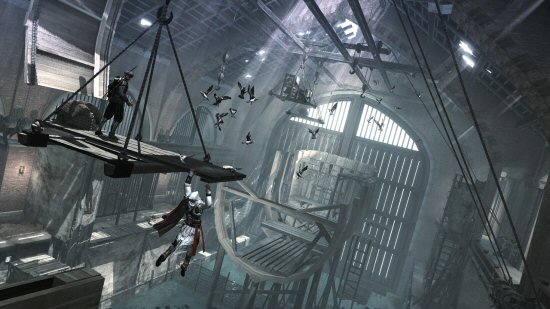
Each location not only looks stunning but is designed with freedom of movement in mind, crafted specifically so you can explore the areas from many different angles and reach different parts of the city in a variety of ways. Quite simply, it's been designed to make the most out of Ezio's movement and flexible animation. It's worked, because the free-running (or parkour) element in Assassin’s Creed is a great deal of fun and there's plenty of scope for experimentation as you jump onto the roof of a market stall, climb up the façade of a building, swing on a wooden beam and lift yourself up onto the rooftops. It takes a while to master the intricacies of Ezio's moves, which require a great degree of timing and environmental awareness to flow smoothly, so it can initially be frustrating as you drop to your death after you've spent a good few minutes climbing a high steeple, but largely it's a joy to explore the detailed environments.
Unlike the last game, we've yet to feel bored traversing the various areas. Occasionally, it's annoying when you get spotted by the guards and then have to spend the next few minutes getting out of their way or seeking a hiding place, just when you were about to reach your final destination, but those times serve as ample warning that Assassin's Creed II isn't a game that should be played gung-ho. Aside from combat sections, it's a stealthy game that requires thought, planning, but also quick decisions and intuition. In fact it flows nicely between these two styles.
Indeed, the pacing of the game is spot-on. Short cut-scenes never feel intrusive or unnecessary and build the story nicely without waffling on, whereas short side missions can be exciting and fast-paced, complementing the slower missions where, for example, you might need to deliver a letter to someone who is surrounded by guards without them seeing you - in this case you need to plan and be stealthy.
The enhancements to the combat system and the addition of new weapons means that fights are more versatile and visually impressive. Enemy A.I. can behave erratically and occasionally, when you're up against multiple enemies outside of a main mission, combat can feel a little wooden and clumsy. It can be hard to shake off guards so sometimes you do have to stand and fight. Combat can get a little repetitive in this sense, though the majority of actual combat-based mission are still a lot of fun and fighting appears to be much smoother than when you've accidentally walked into brawl.
Quests are scattered about freely and there's plenty of choice available so that you can pick and choose your favorite mission type. We found that part of the motivation to want to complete all of the side objectives, aside from being another good excuse to earn some cash, was because they build on the storyline and reveal more information on characters in the game. In fact, each time you meet a characters or discover an area you can access the database to read up on background information. This helps to expand on this living, breathing world, as you learn about its history and empathise with its characters. It just makes it feel all that little bit more real.
Money has added a new dimension to the gameplay and also acts as great motivation for you to explore, carry out as many quests as possible and search for collectibles. With money comes power and buying extra weapons from the blacksmith and getting them repaired, or picking up a bigger pouch from the tailor to carry your goodies, or even furnishing your house with the greatest treasures, makes earning money an addictive addition to the game.
Quite simply, Assassin's Creed II is better than its predecessor. It's more focused and more streamlined towards your enjoyment, which ultimately makes it absorbing and more fun.
Final Score - 9/10

HEXUS related reading
HEXUS.gaming -
news ::
Assassin's Creed II takes top spot over MW2 in PS3 chart
HEXUS.gaming -
features ::
Delving deeper into the mystical world of Assassin's Creed II (2) - Q&A
HEXUS.gaming -
news ::
Assassin's Creed II: Discovery revealed
HEXUS.gaming -
news ::
Splinter Cell Conviction release date nailed down
HEXUS.gaming -
news ::
Ubisoft confirms DRM strategy for PC games
HEXUS.gaming -
features ::
Splinter Cell Conviction co-op mode - The facts
HEXUS.gaming -
features ::
Prince of Persia: The Forgotten Sands - Q&A
HEXUS.gaming -
news ::
Tom Clancy's Splinter Cell Conviction limited edition unveiled
HEXUS.gaming -
previews ::
Tournament of Legends - Wii
HEXUS.gaming -
news ::
Sonic the Hedgehog 4 back to his 2D roots
HEXUS.gaming -
news ::
Shenmue III still possible if console exclusive
HEXUS.gaming -
news ::
Monster Hunter Tri dated for Europe - Wii-Speak confirmed
HEXUS.gaming -
news ::
Bayonetta updated for PS3, loading times reducedAll Ubisoft Entertainment related content on HEXUS
HEXUS.community :: your right2reply
Can anybody tell me a brief summary of the storyline from the first one. feel free to include spoilers and the lot as i cant be bothered to go through AC1 as i felt it was boring. This one looks alot better
Imagine a big city that Indiana Jones would wander around in... kinda Marakesh feel to it.
You're an assassin with the ability to peg it up the wall, over the roof tops and down the other side of a house... but on a vast scale.
You look a lot like Spiderman,,, crouched on top of huge spires and tall towers...looking for people to kill.
When walking through town, you ocassionally think you've been spotted and you peg it .. and if you need too.. you can barge people out of the way...sometimes they get the ump about it.
Occasionally you get cornered and you peg it up a wall and try to run across the roof tops....
I got bored of it after that.... lots of spiderman style wall climbing without acvtually being spiderman... more... free runner style.
But you look more dodgy than a Hole In the Wall Contestant would on an LA beach.... so you get spotted a lot... so you peg it up a wall....Quote
bonus!Quote
Ubisoft has tweeted that the PC version of Assassin's Creed II has been delayed to 2010. Specifically, the game has been moved to the ever-so-crowded first quarter of 2010. According to the necessarily brief announcement, Ubisoft has decided to delay the PC version in order to secure "a bit more time for the dev team to deliver the best quality game."
Quote
Can anybody tell me a brief summary of the storyline from the first one. feel free to include spoilers and the lot as i cant be bothered to go through AC1 as i felt it was boring. This one looks alot better
In September 2012, bartender Desmond Miles is kidnapped by the Abstergo industries company, for use as a test subject in the "Animus", a device that can simulate the memories of his ancestors. Abstergo intends to put Desmond in the device to simulate the memories of his ancestor, Altaïr Ibn La-Ahad, in the "Assassin Clan" during 1191 as part of the Third Crusade in the Holy Land. Desmond has trouble adjusting to the device, but eventually relives Altaïr's exploits over the next several days. The game then primarily takes Altaïr's point-of-view, with occasional swaps to Desmond when he exits the "Animus".
Altaïr is first shown attempting to retrieve one of a series of artifacts known as the "Pieces of Eden" from Solomon's Temple with the help of other assassins, but is stopped by Robert de Sablé, Grand Master of the Knights Templar and sworn enemies of the assassins. While retrieving the treasure, Altaïr breaks all three tenets of the Assassin's Creed ("Stay your blade from the flesh of an innocent," "Hide in plain sight" and "Do not compromise the Brotherhood") within the opening minutes of gameplay to attempt to kill de Sablé, but fails. Upon returning to the Assassins' stronghold at Masyaf and after narrowly defeating a retaliatory attack by the Knights Templar, Al Mualim, leader of the Assassins, demotes Altaïr to an initiate but gives him another chance to rise through the ranks of the Brotherhood. Al Mualim assigns Altaïr the task of assassinating nine key figures across the Holy Land in Jerusalem, Acre and Damascus, to attempt to bring peace between the Crusader and Saracen forces. Each target is based on real historical figures from around 1191, including Majd Addin (Regent of Jerusalem), Garnier de Nablus (Grand Master of the Knights Hospitaller), Jubair al Hakim (an eminent scholar in Damascus), Abu'l Nuqoud (the wealthiest man in Damascus), Robert de Sablé, Grand Master Sibrand of the Teutonic Order and William V, Marquess of Montferrat (Regent of Acre).
Altaïr completes each task, learning how each target is connected to Robert and the Templars, and how together they aim to end the Crusade and place the Holy Land under their own control. With men on both sides killed, he discovers that de Sablé's last ploy is to attempt to unite Christian and Muslim against their new-common enemy, the assassins themselves. Altaïr defeats de Sablé before Richard the Lionheart, failing to convince the king that an end to the war would be welcome to both sides. From de Sablé he discovers that Al Mualim is himself a member of the Knights Templar, and used Altaïr to kill the other members so he could keep the treasure for himself. Altaïr quickly returns to Masyaf to accost his master, who reveals the truth: the Piece of Eden which he had received from one of the men in the Temple after Altaïr's transgression creates illusions. He denounces religion and other seemingly supernatural events (e.g. the parting of the Red Sea, the Ten Plagues of Egypt and the presence of the Greek Gods in the Trojan War) as illusions caused by it, then states his intention to use the artifact to compel mankind into a brainwashed state and so bring an end to all conflict. Altaïr is eventually able to see through deceptions created by the artifact to kill Al Mualim. When Altaïr recovers the artifact, the Piece of Eden activates, showing a holographic view of the world with numerous locations of other Pieces of Eden marked across the globe.
When the process is complete, Desmond learns that Abstergo is a modern-day version of the Knights Templar, and are already seeking other artifacts at locations identified in Altaïr's memory. He further learns that the modern-day assassins had tried to rescue him before the memory was complete but had failed. Desmond was to be killed after completion, but a researcher named Lucy Stillman saves him from death. Though Desmond remains trapped in the Abstergo laboratory, his experience in the Animus has created a "bleeding effect" of Altaïr's life in his own, allowing him to see strange messages painted on the walls of his room, as well as allowing Desmond to use Altaïr's eagle vision (which proves to him that Lucy, who earlier bends down her ring finger as if to show him that she's on his side, is indeed an ally, as she glows blue). The messages all deal with various forms of the end of the world from different cultures, including several references to the date December 21, 2012, the date that Abstergo plans to launch a satellite that will "permanently end the war". It is hinted at that this will be by the same method that Al Mualim hypnotized Masyaf, only on a larger scale. The game ends with Desmond wondering what these images all mean and who could have drawn them.
Couldn't have put it better myself :)Quote
Reply